
Examiner News Desk | Srinagar:
For decades, the question of who could own land in Jammu and Kashmir was inseparable from the region’s special constitutional status. Article 370 and Article 35A were not merely constitutional provisions in the political debate—they were also linked to a legal framework that gave Jammu and Kashmir’s permanent residents special rights over immovable property. The Union Home Ministry itself has recorded that Article 35A, introduced through the Constitution (Application to Jammu & Kashmir) Order, 1954, empowered the erstwhile State legislature to confer special rights on permanent residents, including restrictions concerning acquisition of immovable property. That old legal architecture changed dramatically in August 2019.
The constitutional changes surrounding Article 370 and 35A were followed by the Jammu and Kashmir Reorganisation Act, 2019, which came into force on October 31, 2019, and subsequent adaptation of laws governing land and property in the Union Territory.
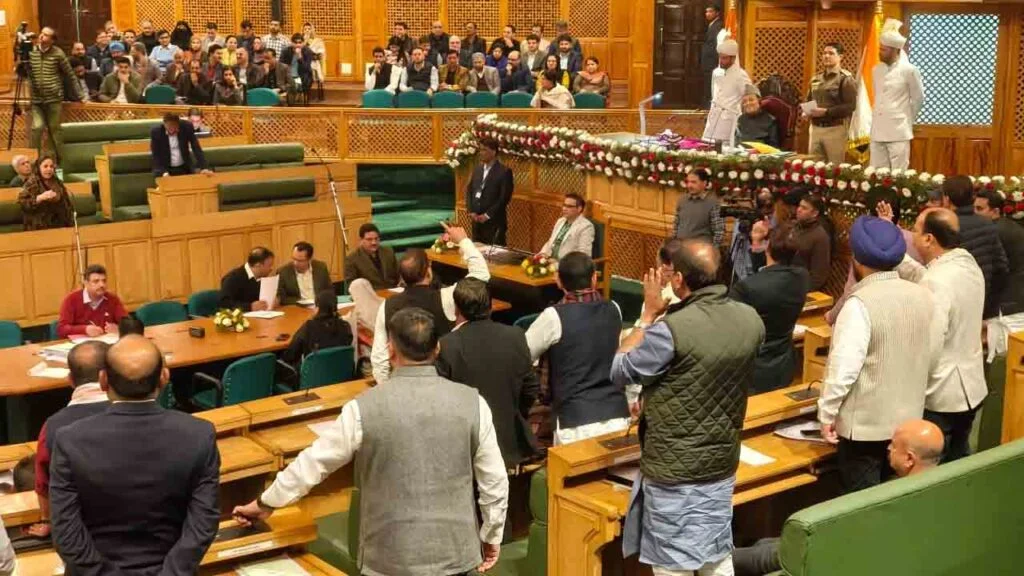
Six years on, the numbers now offer a glimpse into what happened next. According to data placed before the Jammu and Kashmir Legislative Assembly by the Revenue Department, 631 non-residents have purchased 386 kanals and seven marlas-plus of land across J&K since 2019, involving transactions worth ₹129.97 crore.
The more striking figure for the Valley is this: 253 non-residents purchased 173 kanals and seven marlas of land in Kashmir Division for ₹39.49 crore. In Jammu Division, 378 non-residents purchased 212 kanals, 13 marlas and 128 square feet for about ₹90.48 crore.
The figures do not establish that any of these transactions were illegal. But they do establish something that was not possible under the earlier land-ownership framework: hundreds of people classified by the government as non-residents have acquired land in J&K since the post-2019 legal changes.
And that brings the investigation to the question that matters most to Kashmir: Where exactly did those 173 kanals go? Who bought them? What kind of land was purchased? For what purpose? And were all the transactions processed strictly according to law?
From one purchase to 158 in a Year, the government data shows that the process did not begin with a rush immediately after 2019. In 2020, only one non-resident purchased one kanal, for approximately ₹10.06 lakh.
The number rose to 57 buyers in 2021, who purchased more than 24 kanals. It increased further to 127 buyers in 2022, 119 in 2023, 169 in 2024, and 158 in 2025.
The 2025 figure is particularly significant. During that year alone, non-residents purchased 106 kanals, 11 marlas and 201 square feet across J&K, with transactions valued at about ₹37.17 crore.
In other words, the post-2019 land story is no longer about a handful of isolated transactions. It has developed into a measurable pattern of property transactions involving buyers from outside the Union Territory.
The Kashmir’s 173 Kanals, The Missing Map. The Assembly disclosure provides the aggregate figure for Kashmir, but that number raises another question: where are those 173 kanals?
Available reporting based on the government data indicates that buyers from Ladakh, particularly Kargil and Leh, account for a significant proportion of the non-resident purchases. Reports have also identified transactions involving buyers from Delhi and other parts of the country.
An analysis published after the Assembly disclosure reported that Kargil and Leh residents had purchased a majority of plots among the reported outside purchases in Budgam, while buyers from Karnataka and Delhi had shown interest in land transactions around Gulmarg.
Other media reports have identified purchases by Delhi-based entities around Srinagar, including multiple parcels on the city’s outskirts. Those individual transactions, however, require separate verification against registration and revenue records before they can be treated as representative of the entire 253 transactions.
That is the first major gap in the public record.
The government has given the Assembly the number of buyers, area and value, but a complete, publicly accessible district-wise list of the 253 Kashmir transactions would provide a far more meaningful picture.
The issue has assumed greater political significance following allegations over the purchase of land on the outskirts of Srinagar by a non-domicile for a hotel project.
Apni Party president Altaf Bukhari has questioned how such a transaction was permitted and demanded that the government explain who facilitated the purchase, processed the revenue records and authorised the transaction.
Those allegations remain allegations. The fact that 253 non-residents have purchased land in Kashmir does not establish that the particular Srinagar transaction was illegal.
But it does make the demand for greater transparency around individual transactions more relevant.
If the transaction is lawful, the records should establish that.
If there was a violation, the records should also reveal where the process failed.
The legal transformation was substantial.
Before the 2019 changes, Article 35A formed part of the constitutional framework under which Jammu and Kashmir’s permanent residents enjoyed special rights and privileges, including restrictions concerning acquisition of immovable property. The Union Home Ministry has stated that Article 35A was added through the 1954 Presidential Order under Article 370.
Following the constitutional changes in 2019, the Jammu and Kashmir Reorganisation Act, 2019 reorganised the erstwhile State into the Union Territories of Jammu and Kashmir and Ladakh. The Act also provided for adaptation of laws applicable to the new Union Territory.
The Centre subsequently issued the Jammu and Kashmir Reorganisation (Adaptation of Central Laws) Order, 2020, adapting laws for the Union Territory.
The post-2019 framework therefore cannot simply be described as the old system with a new buyer list. It represents a fundamentally different legal environment in which land ownership and investment rules were altered.
The Numbers Need Context
The 631 figure has generated considerable political discussion, but the raw number alone can also be misleading.
The official category is “non-residents”, not necessarily “outsiders” in the everyday political sense.
For example, available reports indicate that a substantial proportion of the buyers were residents of Ladakh, including Kargil and Leh.
This matters because a resident of Kargil or Leh is counted as a non-resident of the Union Territory of Jammu and Kashmir after the 2019 reorganisation, even though the person may have longstanding geographical, cultural, familial or economic links with the wider former State of Jammu and Kashmir.
Therefore, equating all 631 buyers with people who had no previous connection to the region would go beyond what the official data establishes. The same caution applies to the Kashmir figure of 253.
This is arguably the biggest unanswered question. The aggregate Assembly figures establish how much land was purchased and its reported value, but they do not, in the sources publicly available, provide a complete transaction-wise explanation of:
- whether the land was residential or commercial;
- whether it was agricultural or non-agricultural;
- whether it fell within a notified urban or development area;
- whether permission was required for its transfer;
- what the buyer intended to construct or use it for;
- whether construction permissions were subsequently granted;
- whether the land has actually been developed; and
- whether any transaction has subsequently been challenged or cancelled.
Without those details, the 173-kanal figure is a starting point—not the end of the investigation.
The distinction is critical. The government’s disclosure establishes that the purchases took place under the post-2019 legal framework. It does not state that the 253 Kashmir transactions were illegal.
Nor does the existence of a non-resident buyer automatically establish a violation. Every individual transaction has to be tested against the law applicable on the date of purchase, the classification of the land, permissions required and the records maintained by the competent authorities.
That is particularly important in the case of the Srinagar hotel controversy, where political claims and questions about the legality of a particular transaction should not be confused with the broader official statistics.
The political argument surrounding Article 370 and 35A was, among other things, deeply connected to questions of land, permanent residency and the protection of local interests.Today, the official numbers allow the post-2019 transition to be measured for the first time in a concrete way.
253 non-residents.
173 kanals and seven marlas.
₹39.49 crore in Kashmir.
Across J&K, the numbers rise to 631 buyers and ₹129.97 crore worth of transactions. But statistics alone cannot answer whether this has materially changed land ownership patterns in Kashmir. For that, the government would need to disclose the next layer of information.
A district-wise and transaction-wise database of the 253 Kashmir purchases would show exactly where the land was bought. A further breakdown by buyer’s place of residence, land classification, purchase price, intended use, permissions and present status would allow citizens to distinguish legitimate investment from transactions requiring scrutiny.
The most important question now is no longer simply “How many non-residents bought land?” The government has answered that. The more consequential questions are:
Where did the land go?
Who bought it?
What category of land was transferred?
What was it purchased for?
Which authorities approved the transactions?
Were all revenue and registration procedures followed?
How many properties have since been converted, developed or commercially used?
And, in cases where allegations have been raised, did the transaction comply with every applicable provision of law?
Those answers would turn an emotionally charged political debate into a document-based public audit. Six years after the constitutional changes that transformed Jammu and Kashmir’s legal and political landscape, the Assembly’s figures have opened a new chapter in the long-running land debate.
The number—253 non-resident buyers in Kashmir—is now on the official record. The map of those purchases, however, is still largely missing from public view. That is where the next investigation begins.