Examiner Bureau | Srinagar:
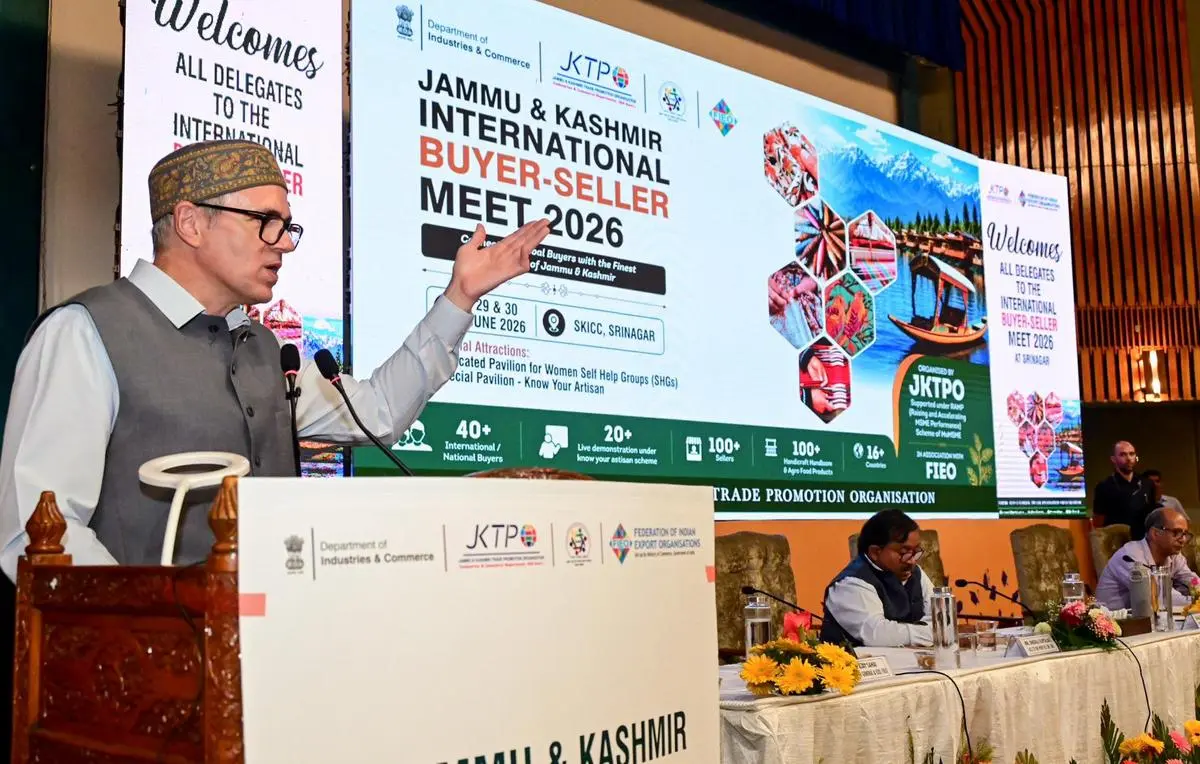
Chief Minister Omar Abdullah on Monday called for creating a new generation of exporters, diversifying Jammu and Kashmir’s export basket and strengthening export infrastructure to achieve the ambitious goal of doubling exports by 2030.
Addressing the inaugural session of the J&K International Buyer-Seller Meet at the Sher-i-Kashmir International Conference Centre (SKICC) in Srinagar, Omar said the Union Government’s target of doubling exports by 2030 leaves Jammu and Kashmir with only a few years to substantially expand its export base.
“We have to support those who are already exporting, but at the same time we need to create exporters out of people who are not exporting today. Their markets are presently confined to Jammu and Kashmir or, at best, some parts of the country. Our effort is to make exporting easier for them,” he said.
The Chief Minister said the Buyer-Seller Meet provides a valuable platform by bringing together international buyers, exporters, manufacturers, artisans and self-help groups to explore new business opportunities and access global markets.
Reflecting on Jammu and Kashmir’s rich trading heritage, Omar said the region historically enjoyed a unique export model in which tourists acted as buyers, purchasing local products and introducing them to markets across the world.
“Our buyers came to us in the form of tourists. They purchased our products and carried them back to different parts of the world. Many lifelong relationships between buyers and artisans were built that way. We rarely had to participate in organised buyer-seller meets or handicraft fairs because buyers automatically came to Kashmir,” he said.
He, however, noted that prolonged disturbances and a decline in tourism forced artisans and traders to adopt new marketing strategies and actively seek buyers beyond the region.
Highlighting the uneven distribution of exports, Omar said nearly 98 per cent of Jammu and Kashmir’s exports currently originate from just four districts, while the remaining districts contribute only two per cent.
“The challenge before us is how to increase the number of exporters and expand exports to every region of Jammu and Kashmir,” he said, stressing the need to broaden the export ecosystem across the Union Territory.
The Chief Minister also underscored the need to establish a dry port in Jammu and Kashmir to streamline export procedures and ensure that exports are officially recorded in the Union Territory.
“We urgently need a dry port. Today our goods are exported from here but are often stamped elsewhere, because of which exports get credited to another state. We are working to ensure all export-related procedures are completed within Jammu and Kashmir itself so that exporting becomes easier for our entrepreneurs and our exports are properly reflected in our own account,” he said.
Action Against Mutton Dealers ‘Unjustified’
Speaking to reporters on the sidelines of the event, Omar termed the action reportedly being taken against Jammu and Kashmir’s mutton dealers in Punjab as “unjustified” and said the issue had once again been taken up with Punjab Chief Minister Bhagwant Mann.
“I have been in touch with the Punjab Chief Minister for months and have written to him again. Our mutton dealers are only using Punjab as a transit route. They are not purchasing livestock there. They should not be punished merely for passing through the state. The action against them is unjustified,” he said.
The Chief Minister said that if the issue remains unresolved, it will be raised before the North Zone State Council and, if necessary, the intervention of the Central Government will be sought to safeguard the interests of Jammu and Kashmir’s traders.
Reiterating his government’s commitment to strengthening the business ecosystem, Omar said every effort would be made to remove hurdles faced by local traders while creating greater opportunities for exporters, artisans and entrepreneurs to expand their footprint in national and international markets.