
Examiner Bureau | Shopian:
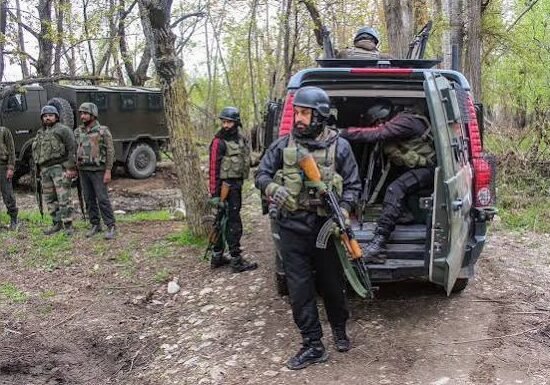
A massive search operation to track down two local militants affiliated with the banned Lashkar-e-Taiba (LeT) entered its fourth day in Jammu and Kashmir’s Shopian district on Tuesday, with security forces resuming combing operations after an overnight pause, officials said.
The search was restarted at daybreak after being suspended during the night. The two militants were first detected by surveillance cameras on July 3 in the dense orchard belt of the Meemandar area, which encompasses seven villages.
A joint team of the Army, Jammu and Kashmir Police and the Central Reserve Police Force (CRPF) has maintained a tight multi-layered cordon around the area. By Monday evening, security forces had completed searches in four of the seven villages under the operation.
According to officials, the trapped militants, identified as Latif and Zakir, allegedly opened fire on Army personnel as security forces tightened the cordon, triggering an exchange of gunfire.
The Army’s specialised counter-insurgency formation, Victor Force, has deployed additional personnel to block all possible escape routes through the dense orchards. The area has also been illuminated during night hours to prevent any attempt by the militants to slip through the security cordon.
Officials said the thick summer foliage provides natural concealment, making aerial and ground surveillance challenging and allowing trapped militants to exploit blind spots to evade security forces.
According to security records, both militants are residents of Kulgam district in south Kashmir. Zakir is believed to have joined the Lashkar-e-Taiba in 2024, while Latif reportedly became associated with the outfit last year.
Shopian has long been considered a strategically significant transit corridor linking south Kashmir with central Kashmir and the Pir Panjal region.
Security officials said that although foreign militants have increasingly been involved in recent attacks, neutralising local operatives such as Latif and Zakir remains crucial to dismantling militant logistics networks and curbing local recruitment.