
Agencies | New Delhi:
Five Congress MPs, including former Union Finance Minister P Chidambaram, were present when the Parliamentary Standing Committee on Finance adopted a report recommending a tiered revenue mechanism for the Unified Payments Interface (UPI), with no dissent recorded in the published minutes, a senior government functionary said.
The development comes amid a political dispute over the Centre’s decision to introduce a 0.4 per cent Merchant Discount Rate (MDR) on specified person-to-merchant UPI transactions above Rs 2,000 from October 15. Person-to-person UPI transfers will remain free under the new framework.
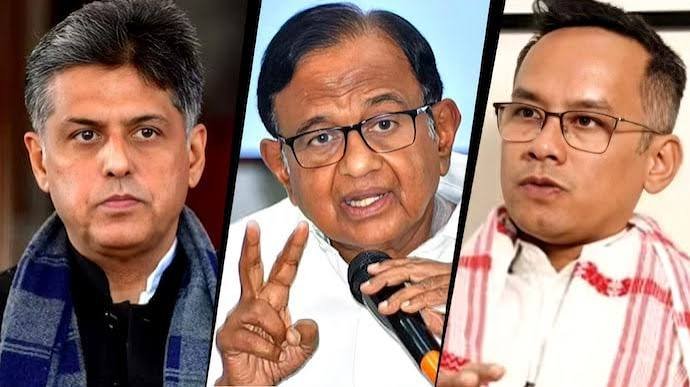
The five Congress MPs — P Chidambaram, Manish Tewari, Gaurav Gogoi, Kishori Lal and K Gopinath — were present when the parliamentary panel adopted its report on August 12, the government functionary said. No dissent by the Congress members was recorded in the minutes, he added.
The government has cited the standing committee’s recommendation while responding to Congress leader and Leader of Opposition in the Lok Sabha Rahul Gandhi, who has criticised the new UPI pricing framework and demanded its withdrawal.
A government functionary questioned why Gandhi was opposing a measure that, according to the government, had been recommended by a parliamentary panel in the presence of Congress members.
Gandhi has described the new framework as a “tax” on UPI and alleged that Prime Minister Narendra Modi was yielding to pressure from the United States. The government has rejected the allegation of foreign influence, maintaining that the policy is an independent domestic decision aimed at making the digital payments ecosystem financially sustainable.
The Finance Ministry has also stressed that the MDR is a charge on eligible merchant transactions and not a fee imposed directly on consumers. It has said person-to-person payments will remain free and that small merchants meeting the specified criteria will continue to be exempt.
The Parliamentary Standing Committee on Finance, chaired by BJP MP Bhartruhari Mahtab, had recommended a tiered MDR or revenue mechanism for UPI and called for its implementation without delay.
The recommendation was based on concerns over the long-term financial sustainability of the UPI ecosystem, which has operated under a zero-MDR framework for several years.
The committee noted that the government had allocated Rs 2,000 crore for 2026-27 to compensate for costs associated with the zero-MDR policy for RuPay debit cards and low-value BHIM-UPI transactions.
At the same time, it highlighted the growing cost of maintaining the digital payments infrastructure, including expenditure on cybersecurity, fraud prevention and network infrastructure.
According to the committee, the government’s existing support covered only a portion of the estimated costs of operating and expanding the ecosystem, creating what it described as a structural funding gap.
The panel therefore called for a transition towards a self-reliant, tiered revenue model, while continuing efforts to expand digital payments in smaller cities and towns.
It also emphasised that a viable revenue mechanism would be necessary to reduce the UPI ecosystem’s dependence on government subsidies and ensure continued investment in infrastructure and security.
Under the framework announced by the National Payments Corporation of India (NPCI), a 0.4 per cent MDR will apply from October 15 to eligible person-to-merchant UPI transactions above Rs 2,000. The charge will be borne by merchants rather than consumers.
The MDR will be capped at Rs 300 per transaction for payments of Rs 75,000 and above. Certain sectors, including railways, telecom, insurance and fuel, will have a separate flat MDR structure. Small merchants receiving up to Rs 1 lakh a month through UPI QR transactions will also remain exempt under the announced framework.
The government has advised banks and payment service providers to ensure that the MDR is not passed on to consumers.
The new system effectively ends the blanket zero-MDR regime for larger merchant transactions that has been in place for more than six years, while retaining free UPI payments for consumers in specified categories and for all person-to-person transfers.
The political dispute over the measure is likely to continue as the October 15 implementation date approaches, with the government arguing that a revenue mechanism is necessary to sustain UPI’s rapid expansion and the Opposition questioning the impact of the new charges on merchants and consumers.