
Examiner News Desk | Srinagar:
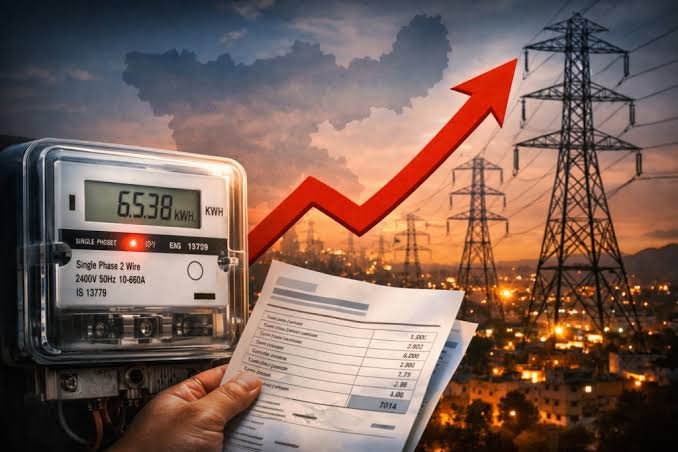
Electricity consumers across Jammu and Kashmir will have to pay higher power bills from September 1, following the approval of an average 6.83 per cent increase in retail electricity supply tariffs for the financial year 2026–27 by the Joint Electricity Regulatory Commission (JERC).
The revised tariff, approved through JERC Order No. 06 of 2026 dated August 20, will remain applicable to electricity consumption from September 1, 2026, to March 31, 2027.
The increase will affect consumers differently depending on their category, monthly consumption and sanctioned load. While regular domestic and commercial consumers will see higher charges, Below Poverty Line (BPL) consumers have been kept outside the tariff hike, providing relief to the most vulnerable households.
For metered domestic consumers, the revised energy tariff has been fixed at Rs 2.45 per unit for monthly consumption up to 200 units.
Consumers using between 201 and 400 units will pay Rs 4.20 per unit, while consumption above 400 units will attract an energy charge of Rs 4.60 per unit.
The fixed charge for domestic consumers has also been increased to Rs 10 per kW per month.
Under the previous tariff structure, domestic consumers paid Rs 2.30 per unit for consumption up to 200 units, Rs 4 per unit for 201–400 units and Rs 4.35 per unit for consumption above 400 units.
The revised energy charges therefore represent an increase of roughly 5 to 6.5 per cent, depending on the consumption slab.
The increase in the fixed charge is more significant, rising by 25 per cent, from the earlier level to Rs 10 per kW per month.
For households with higher sanctioned loads, the increase in fixed charges could therefore add to the overall impact on monthly electricity bills, even if their actual consumption remains unchanged.
In a significant relief for economically vulnerable households, BPL consumers have not been brought under the revised tariff increase.
Consumers in this category using up to 30 units per month will continue to pay Rs 1.40 per unit, along with a fixed charge of Rs 5.
The decision keeps the existing concessional structure intact and ensures that the tariff revision does not place an additional burden on consumers covered under the BPL category.
Agricultural consumers will also continue to benefit from subsidised electricity rates.
For metered agricultural connections with a sanctioned load of up to 20 HP, the energy charge has been fixed at Rs 1.05 per unit.
For agricultural connections above 20 HP, the applicable energy charge will be Rs 6.30 per unit.
The continuation of concessional rates is expected to provide some protection to farmers from the impact of the broader tariff revision.
Commercial establishments will see changes under the new tariff structure.
For single-phase commercial connections, the energy charge has been fixed at Rs 3.75 per unit for consumption up to 200 units and Rs 5.70 per unit for consumption above 200 units.
For three-phase commercial consumers, the tariff has been fixed at Rs 6.15 per kVAh.
The revised rates are expected to have a direct impact on the operating costs of shops, offices, small businesses and other commercial establishments, with the ultimate increase depending on individual consumption patterns.
Alongside the tariff revision, JERC has approved the Aggregate Revenue Requirement (ARR) for the two power distribution corporations operating in Jammu and Kashmir.
The approved ARR stands at Rs 5,095.82 crore for Jammu Power Distribution Corporation Limited (JPDCL) and Rs 5,179.90 crore for Kashmir Power Distribution Corporation Limited (KPDCL).
The Commission has also taken into account Rs 2,420.78 crore in tariff-related subsidy support committed by the Jammu and Kashmir Government.
The subsidy component is intended to support the existing concessional tariff arrangements and help cushion the impact of the revised rates on specified categories of consumers.
For ordinary households, the impact of the revision will ultimately depend on how much electricity they consume each month and their sanctioned load.
A household consuming less than 200 units will see a relatively smaller increase in its energy charges compared with a high-consumption household falling into the upper tariff slab. However, the increase in the fixed charge will apply separately based on the sanctioned load.
Consumers using more than 400 units a month will face the highest domestic energy rate under the revised structure, at Rs 4.60 per unit.
This means the new tariff structure continues to encourage consumers to keep electricity consumption within lower slabs, while placing greater charges on higher consumption.
The Commission has kept miscellaneous charges unchanged, meaning the tariff revision is primarily reflected in the revised energy and fixed charges applicable to the respective consumer categories.
The actual amount payable on each electricity bill will therefore vary from household to household and business to business.
With the new rates coming into force on September 1, consumers across Jammu and Kashmir will begin seeing the impact in bills generated for electricity consumed after the effective date.
The tariff revision comes against the backdrop of the financial requirements of the two distribution companies and the need to balance revenue requirements with consumer affordability.
While the overall average increase has been pegged at 6.83 per cent, the actual impact will not be uniform. Domestic consumers, commercial establishments and other categories will experience different levels of increase depending on their applicable tariff slabs.
At the same time, the continuation of BPL and agricultural concessions, along with government subsidy support, is aimed at ensuring that the tariff revision does not disproportionately affect vulnerable sections and priority sectors.
For consumers, however, the message is clear: electricity will cost more from September 1, making consumption levels and sanctioned load increasingly important factors in determining monthly power bills.