
Agencies | New Delhi:
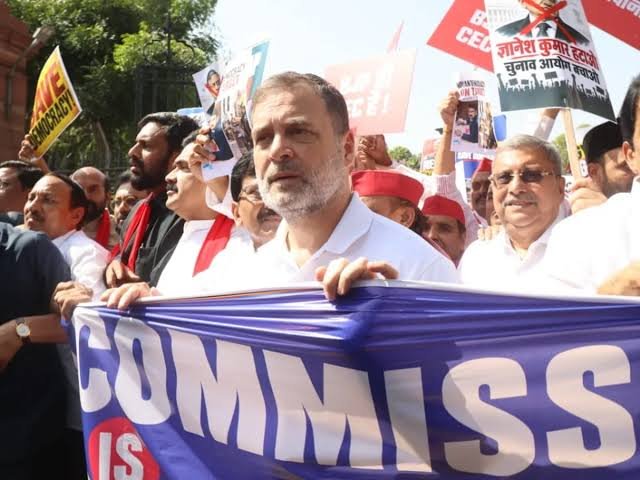
The INDIA bloc is expected to scale back its daily street protests against the Election Commission and Chief Election Commissioner Gyanesh Kumar during the ongoing festive season, even as the Opposition maintains that its campaign over alleged electoral irregularities is far from over.
After five consecutive protest marches in Delhi and a fresh petition in the Supreme Court challenging the Chief Election Commissioner and the Special Intensive Revision (SIR) of electoral rolls, opposition parties have decided to reconsider the frequency of their demonstrations, citing festival commitments and the difficulty of sustaining daily mobilisation.
According to The Economic Times, a meeting of INDIA bloc leaders convened by Congress leader Rahul Gandhi concluded that regular joint marches would be difficult to sustain through the festive period, which includes Durga Puja, Dussehra, Diwali and Chhath. The alliance is therefore expected to organise protests intermittently rather than maintain a daily schedule.
The move is being viewed as a change in the pace of the campaign rather than an end to the Opposition’s agitation against the Election Commission.
Addressing a press conference after the meeting, Rahul Gandhi indicated that the alliance would continue its campaign, suggesting that its next move could come soon or after a longer interval. He also hinted at a “surprise” but declined to disclose details, while reiterating the Opposition’s intention to challenge restrictions on protests at Jantar Mantar.
The decision follows an intense week of mobilisation in the national capital, culminating in a march towards the Supreme Court and the filing of a petition concerning the SIR exercise and the Chief Election Commissioner.
The immediate challenge for the INDIA bloc is to maintain public attention on the issue while leaders and party workers return to their home states for festival-related commitments and preparations for upcoming elections.
According to The Economic Times, some leaders proposed taking the protests to other states, including Varanasi, Prime Minister Narendra Modi’s Lok Sabha constituency. However, Delhi was considered to offer greater visibility and political impact.
The Congress is also scheduled to hold a rally in the national capital on November 1.
India Today reported that the alliance was unlikely to organise a major street protest in Delhi before Dussehra, although further demonstrations remained under consideration. The next action could be announced shortly before it takes place, allowing the Opposition to retain an element of surprise.
The shift in strategy comes amid wider demonstrations involving political parties, student groups and civil society organisations over the Election Commission, the SIR exercise and alleged irregularities in electoral rolls.
Beyond street demonstrations, the Opposition is seeking to broaden its campaign by involving civil society groups and student organisations.
At a high-tea meeting attended by political representatives and members of civil society, participants discussed building a wider coalition around demands for democratic accountability, an impartial electoral process and a level playing field, India Today reported.
Representatives of several opposition parties, including the Congress, Rashtriya Janata Dal, Nationalist Congress Party (Sharadchandra Pawar), Shiv Sena (UBT), Samajwadi Party, Left parties and the Trinamool Congress, reiterated their commitment to continuing the campaign against the Chief Election Commissioner, the SIR exercise and the policies of the Modi government.
The alliance now faces the task of converting the momentum generated by its high-profile marches into a sustained campaign through legal action, inter-party coordination and wider public mobilisation.
While daily demonstrations may be scaled back during the festive period, opposition leaders have indicated that further action remains on the table as they seek to keep electoral-roll issues and their concerns about the Election Commission in the public debate.