
By: Irfan Gull (Kashmir Examiner)
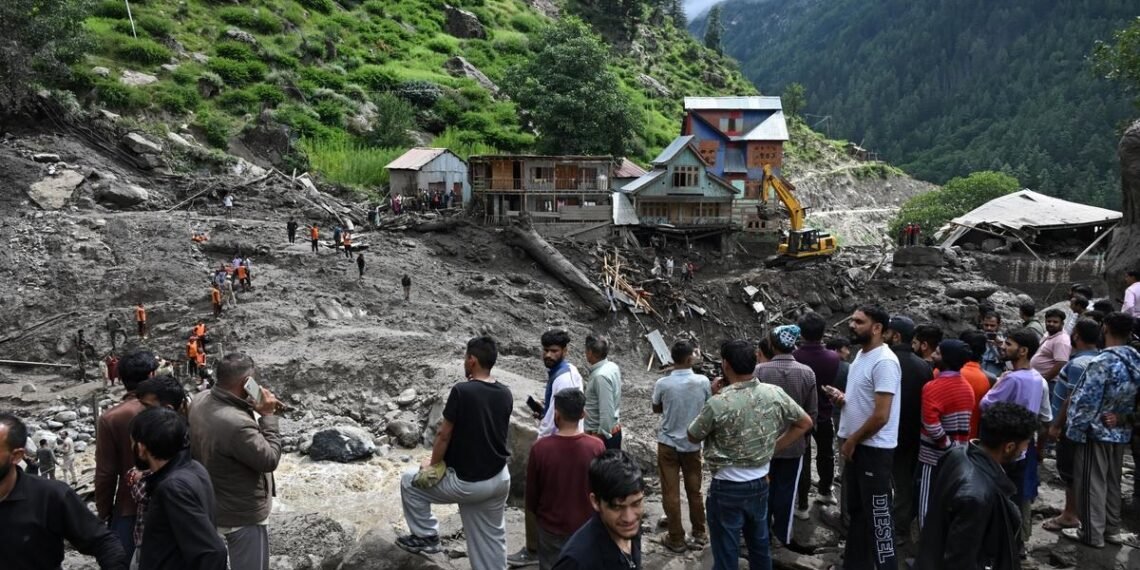
Jammu and Kashmir has witnessed more than 35 cloudbursts so far this year, leaving 31 people dead and causing widespread destruction to homes, roads, bridges, agricultural land and public infrastructure, underscoring the growing threat posed by extreme weather events in the ecologically fragile Himalayan region.
Official figures show that 22 cloudbursts were recorded between June 1 and mid-July. Fresh spells of intense rainfall during the second half of July and the first week of August triggered several more incidents, taking the total number of reported cloudbursts to over 35.
Most of the fatalities have been caused by cloudbursts, flash floods and rain-triggered landslides, with the Jammu division accounting for the highest number of deaths. The worst-affected districts include Poonch, Rajouri, Kathua, Doda and Kishtwar, while in the Kashmir Valley, Shopian, Kupwara, Bandipora and Anantnag have witnessed repeated cloudbursts and flash floods over recent weeks.
The latest spell of extreme weather on Monday claimed two lives after multiple cloudbursts struck different parts of the Union Territory, including Kupwara, Shopian, Bandipora, Anantnag and Kishtwar, while torrential rain disrupted normal life across both the Kashmir and Jammu divisions.
Extensive Damage Across Districts
Officials said recurring cloudbursts have caused extensive damage to residential houses, schools, shops, roads, bridges, irrigation canals and power infrastructure this year. Large tracts of agricultural land and orchards have also been inundated, affecting livelihoods in several rural areas.
Flash floods have repeatedly swept through villages, forcing district administrations to evacuate residents, deploy rescue teams and restore damaged infrastructure under challenging weather conditions.
Several roads, including rural link roads, have been washed away, while bridges and culverts have suffered structural damage, disrupting connectivity in remote mountainous regions.
Chenab Valley Emerges as the Worst-Hit Region
The Chenab Valley, particularly Doda and Kishtwar, has emerged as the region most vulnerable to cloudbursts and flash floods this year.
Disaster management officials attribute the area’s vulnerability to its rugged topography, steep mountain slopes, fragile geology and numerous seasonal streams that respond rapidly to intense rainfall.
In Kashmir, the upper reaches of Shopian, Kupwara, Bandipora and Anantnag have also experienced repeated flash floods triggered by highly localised cloudbursts.
The strategic Jammu-Srinagar National Highway, the Union Territory’s primary road link with the rest of the country, has witnessed repeated closures due to landslides, mudslides and shooting stones triggered by heavy rainfall, disrupting passenger movement and affecting the supply of essential commodities.
Why Cloudbursts Are Becoming More Frequent
Meteorologists define a cloudburst as an extremely intense and highly localised rainfall event in which more than 100 millimetres of rain falls within an hour over an area of approximately 20 to 30 square kilometres. Such events often trigger devastating flash floods, debris flows and landslides, leaving little time for evacuation.
According to weather experts, the increasing frequency of cloudbursts in Jammu and Kashmir is linked to the interaction between moisture-laden southwest monsoon winds and western disturbances over the Himalayan region.
As moisture-rich air is forced to rise rapidly over steep mountain slopes—a process known as orographic lifting—towering cumulonimbus clouds develop. These clouds often become trapped within narrow valleys, where they continue accumulating moisture before collapsing suddenly, releasing enormous volumes of rain over a limited area.
Scientists also point to increasing atmospheric instability. Powerful upward air currents keep water droplets suspended inside storm clouds, allowing them to grow larger. When these updrafts weaken under the increasing weight of accumulated water, the cloud system collapses, resulting in an intense burst of rainfall.
Climate experts caution that rising global temperatures are increasing the atmosphere’s capacity to hold moisture, raising the likelihood of short-duration but extremely intense rainfall events in mountainous regions such as the Himalayas.
Experts Call for Stronger Preparedness
The growing frequency of cloudbursts has renewed calls for strengthening disaster preparedness across Jammu and Kashmir.
Recent assessments by the India Meteorological Department (IMD) and the Geological Survey of India (GSI) have highlighted an increasing trend in mountain hazards and recommended significant improvements in weather forecasting and early warning systems.
The studies advocate the installation of X-band Doppler weather radars, expansion of automated weather station networks, and deployment of real-time community alert systems to provide timely warnings before extreme weather events.
Experts have also recommended comprehensive hazard mapping of vulnerable mountain slopes and flood channels, stricter regulation of construction in floodplains, dry riverbeds and landslide-prone areas, and more sustainable urban planning in ecologically fragile regions.
They have further emphasised the need for large-scale afforestation, protection of wetlands, restoration of natural drainage systems and climate-resilient infrastructure to minimise the impact of flash floods and landslides.
With the monsoon expected to continue for several more weeks, authorities remain on high alert, while meteorologists have warned that brief but intense spells of rainfall could trigger additional cloudbursts, flash floods and landslides in vulnerable parts of the Union Territory.