
Agencies | Washington:
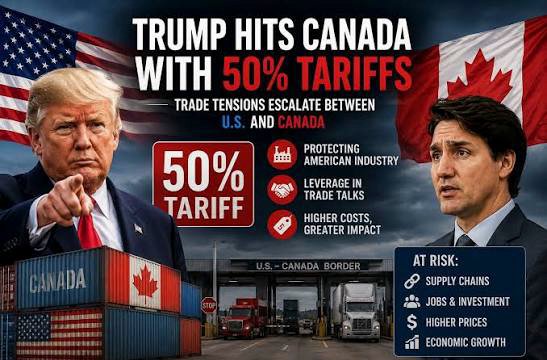
US President Donald Trump has announced another major tariff increase on Canadian imports, threatening to raise duties on Canadian cars, trucks, automotive parts and steel to 50 per cent from January 1, 2027, as the long-running trade dispute between Washington and Ottawa intensifies.
In a post on Truth Social on Monday, Trump accused Canada of benefiting unfairly from access to the US market and criticised what he described as excessively high Canadian tariffs on American agricultural products.
“Canada has been ripping off the United States of America for years,” Trump wrote, arguing that Canadian tariffs on US farmers and agricultural products had contributed to what he described as a $60 billion trade deficit between the two countries.
Trump said the higher tariffs on Canadian vehicles, automotive components and steel would take effect from January 1, 2027, while urging companies to shift production to the United States.
“Build in the U.S. and there are ZERO TARIFFS,” he said.
The US President also took a hard line against Canada’s trade position, arguing that Ottawa was more dependent on the American market than the United States was on Canada.
“They feel entitled and, yet, WE DON’T NEED CANADA, THEY NEED US!” Trump said.
The announcement came only days after Canada unveiled plans for retaliatory tariffs on American goods in response to Washington’s latest trade measures, adding another layer to an increasingly complex economic dispute.
Canadian Prime Minister Mark Carney has said Ottawa will impose dollar-for-dollar tariffs on US goods beginning September 8.
The move followed Washington’s introduction of new 50 per cent tariffs covering approximately $20 billion worth of Canadian exports.
Canada’s proposed countermeasures are expected to affect a range of American products, including steel, dairy products, electronics and other goods.
Carney said the decision followed unsuccessful trade discussions between the two countries. Ottawa has maintained that it cannot accept US demands that it believes would adversely affect Canada’s economic interests.
The latest tariff exchange is part of a broader trade confrontation that has unfolded through successive rounds of duties and retaliatory measures.
The Trump administration previously imposed a 25 per cent tariff on most Canadian imports in 2025. Duties on Canadian steel and aluminium were subsequently increased to 50 per cent, while Washington also imposed a 25 per cent tariff on Canadian automobiles and auto parts.
Canada responded with retaliatory tariffs covering various American products. Although some of those measures were subsequently withdrawn, tariffs affecting sectors such as US steel, aluminium and automobiles remained central to the dispute.
The latest announcements indicate that neither side has yet found a durable compromise on the trade issues separating the two countries.
The escalating tariff measures could place additional pressure on companies operating across the US-Canada border, particularly manufacturers and suppliers whose production chains span both countries.
The automotive sector is especially vulnerable because vehicles and components frequently cross the border multiple times during the manufacturing process. Higher tariffs could therefore increase production costs and potentially translate into higher prices for consumers.
Steel and other industries that rely heavily on cross-border supplies could also face increased costs as companies adjust sourcing and production strategies.
With Canada preparing its latest retaliatory measures from September 8 and Trump threatening significantly higher tariffs from January 2027, the dispute risks becoming a prolonged confrontation with consequences for businesses, workers and consumers on both sides of the border.