
Agencies | Theran:
Iran has warned that it could halt oil exports through the Strait of Hormuz and elsewhere in the Persian Gulf if the United States continues what Tehran describes as an “economic war” against the country.
Mohsen Rezaei, secretary of Iran’s Supreme National Security Council, issued the warning as Washington prepared to announce a fresh round of economic sanctions targeting Iran and countries maintaining trade ties with Tehran.
“If the economic war continues, not a single drop of oil will be exported, neither through the Strait of Hormuz nor from anywhere in the Persian Gulf,” Rezaei said in a post on X.
He further warned that Iran would regard any country participating in or supporting the US economic campaign against Tehran as committing an “act of war”.
The warning came as the United States prepared what Washington described as a major new financial offensive against Iran.
According to Reuters, US Treasury Secretary Scott Bessent was scheduled to hold a press conference on Monday amid expectations of tougher economic measures targeting Iran’s trade partners.
In an opinion article published in the Financial Times on Sunday, Bessent described the planned measures as “the single greatest financial offensive ever marshalled against an adversary”, Reuters reported.
While details of the measures were not immediately disclosed, Bessent indicated that Washington would target countries continuing to engage with Iran’s economy and financial system.
He also warned countries against what he described as “appeasement” through continued economic ties with Tehran.
Iran has responded to the anticipated sanctions with a series of increasingly strong warnings, raising concerns over the potential impact on regional energy supplies and international shipping.
Rezaei’s warning extended beyond the United States to countries that could participate in or support Washington’s economic campaign.
“Iran will regard any country’s participation in or support for America’s economic war against the Iranian people as an act of war,” he said.
Reuters reported that Bessent had previously urged China to cooperate with Washington, noting the importance of Gulf oil supplies to the Chinese economy.
A spokesperson for China’s embassy in Washington said that “sanctions and pressure do not help resolve the problem” and called for diplomacy.
Iranian Parliament Speaker Mohammad Bagher Ghalibaf also criticised the latest US sanctions threat, using satire to suggest that excessive economic pressure could ultimately backfire.
Ghalibaf referred to what he called the “Iran boomerang”, accompanying his remarks on X with a four-panel cartoon depicting a giant boomerang labelled “the most crushing economic operation ever” returning to strike its launcher.
Meanwhile, Islamic Revolutionary Guard Corps spokesperson Sardar Mohebi described Washington’s reliance on economic pressure as an indication of what he characterised as a “humiliating defeat” on the military front, according to ANI, citing Iran’s IRIB.
“The US President says that he has ordered economic warfare and has launched the most severe economic war against Iran. This is a tacit admission of the enemy’s humiliating defeat in the military arena,” Mohebi said.
Iranian Foreign Ministry spokesperson Esmaeil Baghaei also criticised the sanctions threat, saying that war and sanctions were not unfamiliar experiences for Iran.
Iran’s economy was already facing the impact of international sanctions before recent US and Israeli attacks damaged parts of the country’s infrastructure, according to Reuters.
The country is now confronting additional economic pressures arising from disrupted trade, reduced production, infrastructure damage and the cost of reconstruction.
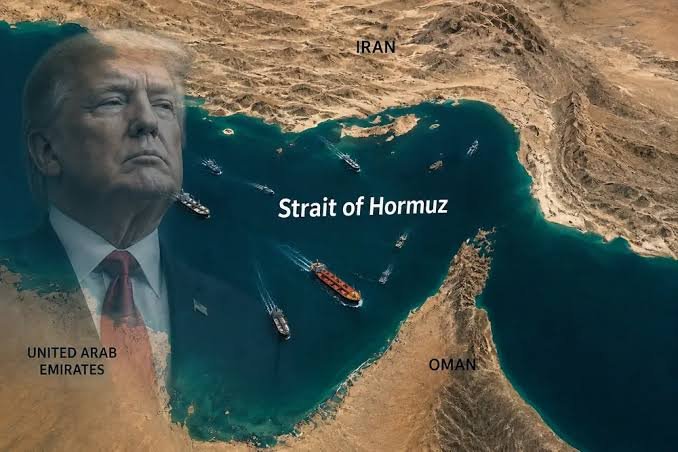
The situation has also raised concerns over the security of oil shipments through the Strait of Hormuz, one of the world’s most strategically important energy corridors.
Reuters reported that Iran retains missile and drone capabilities that could potentially threaten Gulf neighbours and oil tankers operating in or around the waterway. The resulting security concerns have contributed to a sharp disruption in shipping through the Strait and increased pressure on global fuel markets.
The precise condition of Iran’s nuclear programme also remains uncertain, Reuters reported, as the United States and Israel continue efforts aimed at preventing Tehran from advancing its nuclear capabilities.
The Strait of Hormuz has emerged as a critical pressure point in the latest confrontation. The narrow waterway connects the Persian Gulf with the Gulf of Oman and is a major route for global energy shipments.
Any sustained disruption could have consequences far beyond the Middle East, potentially affecting crude oil supplies, shipping costs and fuel prices in international markets.
Iran’s latest warning therefore represents not only a direct challenge to Washington’s sanctions strategy but also a potential threat to one of the world’s most important energy corridors.
The latest escalation comes as Washington and Tehran have reportedly gone weeks without direct military strikes against each other, while meaningful negotiations aimed at ending the months-long confrontation have yet to materialise.
With sanctions pressure increasing and Tehran warning of possible retaliation against Gulf oil shipments, the risk of a wider regional and economic crisis remains a major concern for global markets.