
Agencies | Mascow:
Early results from Russia’s first parliamentary election since the launch of the full-scale war in Ukraine show President Vladimir Putin’s ruling United Russia party maintaining a strong lead.
The three-day election, which began on Friday and concluded on Sunday, was held to elect members of the 450-seat State Duma, the lower house of Russia’s parliament. The vote took place amid limited political competition, with most prominent anti-war candidates barred from contesting.
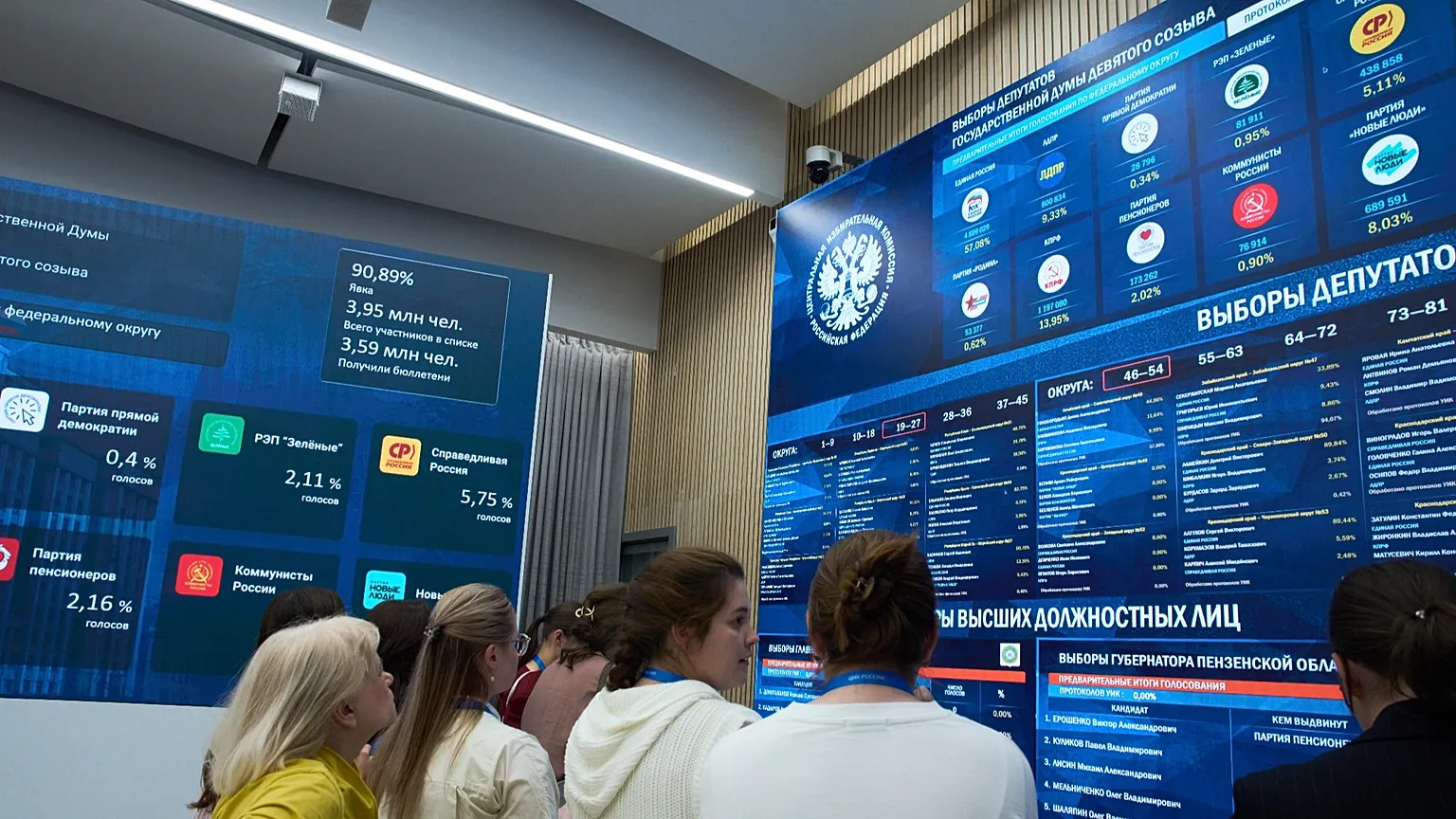
According to Russia’s state-run TASS news agency, citing data from the Central Election Commission (CEC), United Russia had secured 57.86 per cent of the vote after more than 90 per cent of ballots were counted. The party was also projected to win a large majority of the 225 single-member constituency seats.
The CEC put voter turnout at just under 57 per cent, while more than 3.6 million people reportedly cast their ballots online, according to Russia’s Ministry of Digital Development, Communications and Mass Media.
The election was presented by the Kremlin as an opportunity for Russians to express their views amid the continuing war in Ukraine and economic pressures at home. Critics, however, have pointed to the restricted political environment and the limited presence of opposition candidates.
Most anti-war candidates were barred from the ballot. Candidates from the liberal Yabloko party said they faced pressure, while party leader Nikolai Rybakov reportedly spoiled his ballot by writing the party’s name along with the slogan “For peace”.
The Communist Party of the Russian Federation (CPRF) was in second place in the early count with 13.84 per cent, followed by the Liberal Democratic Party of Russia (LDPR) with 8.9 per cent, New People with 7.94 per cent and A Just Russia with 4.95 per cent, according to TASS.
All four parties were on course to secure representation in the State Duma.
The Berlin-based NEST think tank, co-founded by Kremlin critic Mikhail Khodorkovsky, said votes going to some of the parliamentary parties could partly reflect dissatisfaction with the government, although those parties generally support the Kremlin on major issues.
NEST said the economic and social consequences of the war could influence voter behaviour, with some voters potentially using their ballots to express frustration while still choosing parties permitted to participate in the election.
The election also included voting in four Ukrainian regions—Donetsk, Luhansk, Kherson and Zaporizhia—that Russia claimed to annex in 2022, as well as Crimea, which Moscow annexed in 2014.
Ukraine has rejected the elections in the occupied territories as illegal. The United Nations and most countries do not recognise Russia’s claims over Crimea or the four Ukrainian regions.
In the previous State Duma election in 2021, United Russia won 326 of the 450 seats, retaining an absolute majority. The CPRF emerged as the second-largest party with 57 seats.
The CEC was expected to release preliminary results and turnout figures on Monday, while the final results were expected later in the week after the completion of counting and other legal procedures.
Ukraine criticised the election, particularly the participation of voters in territories under Russian occupation.
Moscow, meanwhile, accused Ukraine of attempting to disrupt the vote following a wave of drone attacks targeting Moscow and other Russian regions on Sunday.
Russian authorities said the attacks killed several people and damaged infrastructure, including a facility at a Moscow oil refinery. Further casualties were reported in Russia’s Bryansk region in a separate drone attack on Monday.
The election comes as Russia continues its war in Ukraine, with the vote taking place against the backdrop of ongoing military operations, economic pressure and heightened tensions between Moscow and Kyiv.