
Examiner Bureau | Srinagar:
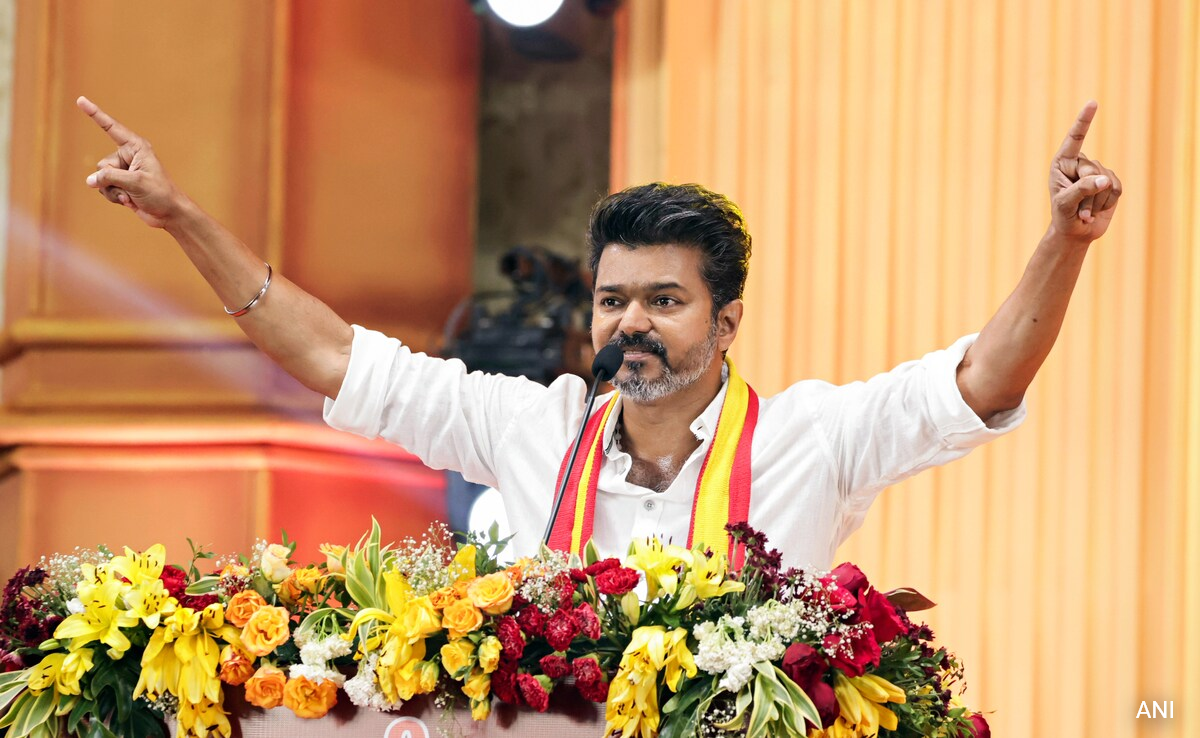
The political situation in Tamil Nadu has entered a constitutional grey zone after reports emerged that Governor Rajendra Arlekar remains unconvinced about the majority claim made by Vijay and his Tamilaga Vettri Kazhagam (TVK)-Congress alliance.
Although the alliance has formally staked claim to form the government, its combined strength currently stands at 112 seats — 107 held by TVK and five by the Congress — still six short of the crucial 118-seat majority mark in the 234-member Assembly.
The development has shifted attention from the electoral outcome to the constitutional role of the Raj Bhavan, where the Governor is now tasked with determining whether the alliance can demonstrate a stable and sustainable majority.
Governor’s Role in a Hung Assembly
Under Article 163 of the Constitution, the Governor exercises discretionary powers in situations where no party or alliance secures a clear majority. The Governor’s primary responsibility is to appoint a Chief Minister who is most likely to command the confidence of the House.
Constitutional experts note that this is not merely a numerical exercise but also a judgement about political stability. In such scenarios, the Governor may invite the single-largest party, a pre-poll alliance, or even a post-poll coalition, depending on the credibility of their support.
Sources indicate that Governor Arlekar is carefully evaluating whether the TVK-Congress arrangement has the backing needed to survive a floor test or whether the alliance remains vulnerable to instability.
Possibility of Floor Test
The Governor may seek documentary proof of support, including letters from Independent legislators or smaller parties, before inviting the alliance to form the government.
While the landmark S. R. Bommai v. Union of India judgement established that a majority must ultimately be proven on the Assembly floor, the Governor retains the authority to verify claims before administering the oath of office.
If the Raj Bhavan remains unconvinced, a time-bound floor test could be ordered after government formation. However, officials suggest the Governor may avoid inviting any alliance that appears numerically fragile in order to prevent political instability or allegations of horse-trading.
President’s Rule Not Ruled Out
If no party or coalition is able to demonstrate a viable path to majority, the Governor can submit a report to the President under Article 356, potentially paving the way for President’s Rule in the state.
Constitutional observers, however, point out that such a step is considered a measure of last resort, with the Governor expected to exhaust all democratic possibilities before recommending central intervention.
High-Stakes Political Transition
The ongoing uncertainty carries added political significance as TVK, led by Vijay, has emerged as a disruptive force in Tamil Nadu politics, challenging the long-standing dominance of traditional Dravidian parties.
Political analysts believe the Governor’s cautious approach reflects an attempt to ensure that any transition of power is backed by a verifiable legislative mandate and does not collapse at the very first session of the Assembly.
With negotiations and backchannel discussions expected to intensify, the next 48 hours are likely to prove decisive in determining whether Tamil Nadu gets a new government or slips into deeper constitutional uncertainty.